IN TIME
One frame predicts the next
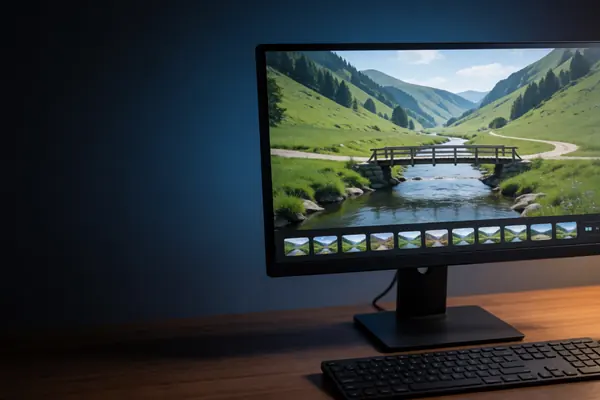
Motion-compensated prediction builds each frame from a previous reference frame, then sends only the prediction error.
Meet the frames prohdreviews
00VIDEO CODECS, EXPLAINED

Video is shrunk by not sending what the decoder can guess.
Neighbouring pixels look alike, and one frame looks a lot like the next. Codecs such as MPEG-2, H.264 and HEVC exploit both, and also throw away fine detail the eye barely notices. The result is a stream a fraction of the size of the raw picture.
Meet the frames01Principles
02THE SHORT ANSWER
Codecs remove redundancy in the signal
and detail the human eye will not miss.
IN TIME
Motion-compensated prediction builds each frame from a previous reference frame, then sends only the prediction error.
Meet the framesFAST MOTION
Each frame's motion is predicted, and the leftover error is coded. The BBC paper notes that at the lower bit rates the coding impairments become increasingly objectionable.
See the numbersIN SPACE
Small 8 by 8 pixel blocks are transformed and their fine-detail values coarsened, because the eye responds less to fine spatial detail.
How blocks work03MEET THE FRAMES
MPEG-2 defines three picture types, and later codecs build on the idea. Pick one to see how it is coded. The bar shows how much compression it offers.
Based on the Library of Congress format description for MPEG-2 video and a 1995 BBC R&D paper.
04TWO NUMBERS WORTH KNOWING
One figure on the raw signal,
one on how far codecs have moved.
124 Mbit/s
Uncompressed standard-definition TV, 4:2:0
A 720 by 576 picture at 25 frames a second needs about 124 Mbit/s raw. The BBC paper says around 6 Mbit/s was thought a good compromise for terrestrial broadcasts.
RAW VIDEO · BBC R&D 1995
22–43%
Objective efficiency gain of HEVC over H.264
Across four sets of coding choices, HEVC improved on H.264 by 22% to 43% on an objective measure. Subjective tests suggested bit rate savings of 55% to 87%.
HEVC VS H.264 · LIBRARY OF CONGRESS
The same Library of Congress description notes up to 76% improvement in a separate objective test at 4K (3,840 by 2,160 pixels).
05FOUR THINGS TO KNOW
Once you know how a codec works, some familiar picture faults make sense.
Squeeze the stream too hard and coding impairments become increasingly visible.
H.264 and HEVC include a deblocking filter that smooths block edges.
Decoding can begin only at access points, which I-frames provide periodically.
Quantisation is not reversible, so a compressed picture is a close approximation, not a copy.
06INSIDE A BLOCK

In MPEG-2, each 8 by 8 block goes through a discrete cosine transform, which tends to concentrate the picture's energy into a few low-frequency values. Those values are then quantised, with high-frequency detail coarsened most, and the result is scanned in a zigzag and coded compactly.
Later codecs made the blocks flexible. H.264 used a fixed 16 by 16 macroblock; HEVC uses a coding tree unit of up to 64 by 64 that can split down to 4 by 4, which helps especially at high resolutions.
07Questions
A coder and decoder pair. The BBC R&D paper describes a bit rate reduction system that removes redundant information at the coder and re-inserts it at the decoder.
Usually not. The H.264 specification, quoted by the Library of Congress, says the algorithm is not lossless, and quantisation discards less important visual information.
The Moving Picture Experts Group started in 1988 within ISO/IEC. MPEG-1 was published in 1993, and MPEG-2 had its first approvals in 1994.
Broadcast formats: standard-definition TV at about 3 to 15 Mbit/s and high-definition TV at 15 to 30 Mbit/s, according to the 1995 BBC paper. It was widely adopted for DVD.
HEVC, also called H.265, was first published in 2013 by ISO/IEC and ITU-T, as an evolution of earlier standards including H.264.
08Sources
ABOUT THIS NAME
prohdreviews.com is part of the DoodleSale portfolio. It isn't in an auction right now, but you can ask about leasing it.